

A Lifetime in Music: How Gilchrist’s Music Therapy Helps Mary Austin Stay Connected to What She Loves
At 90 years old, Mary Austin still lights up when music fills the room. Whether she’s softly singing along to a familiar hymn, reminiscing about years spent playing piano and ukulele, or listening to music on YouTube each night before bed at Charlestown Senior Living Community in Catonsville, music remains one of the deepest threads woven throughout her life.
Now receiving hospice care from Gilchrist, Mary has found comfort and connection through Gilchrist’s Music Therapy Program, where music therapist Jillian Reed visits to sing, harmonize, and share meaningful musical moments together. For Mary, music has never simply been a hobby. It has shaped her life, her career, her faith, and her family for nearly nine decades.
Deep Roots in Southern Maryland
Mary grew up in Calvert County near Chesapeake Beach in a close-knit farming community where church and family were at the center of daily life. “My whole family has lived there for generations,” Mary shares. “My parents helped build the Methodist church there, and there are still stained glass windows in the church with our family name on them.”
After graduating from high school in 1954, Mary attended Western Maryland College on a senatorial scholarship. Though unsure of her path at first, everything changed after an impromptu piano audition with one of the school’s music professors. “She told me to play something for her,” Mary recalls. “I played part of the Warsaw Concerto, and she stopped me after a couple of pages and said, ‘Okay, fine. You’re in.’”
During college summers, she worked at a hotel in Ocean City, serving breakfast to guests before spending afternoons playing ukulele on the beach. “Those were some of the most lovely years of my life,” she says with a smile. Mary went on to study music and education before later transferring to American University, where she earned a degree in elementary education.
A Life Filled with Music, Family, and Adventure
Music remained a constant throughout Mary’s life. She taught elementary school for several years before spending more than 40 years teaching private piano lessons while raising her two children, Joe and Lauren. Along the way, she passed down her love of music to them as well. Joe developed a talent for playing instruments by ear, while Lauren went on to study flute at UMBC with instruction connected to Peabody Conservatory.
Music remained an important part of Mary’s life through the years. She played piano for church choirs, sang in performances, and later joined The Harmonizers choir at Charlestown. “The music was challenging and different,” Mary says of singing with the group. “I really enjoyed that.”
Outside of music, Mary embraced many new adventures throughout the years. After raising her family, she launched a successful second career in real estate in her 50s and continued working for more than 25 years. Around that same time, she discovered a passion for snow skiing, joining ski clubs and organizing family ski weekends. “I loved it,” Mary says with a smile.
Finding New Joy Through Music Therapy
Today, Mary faces the challenges of neuropathy and declining mobility, which have made it difficult for her to continue playing piano. “I was a skier and a piano player, and now I can’t walk or play piano because of neuropathy,” she shares. “That’s why I picked up the little ukulele. I can still sit and play with my chords.”
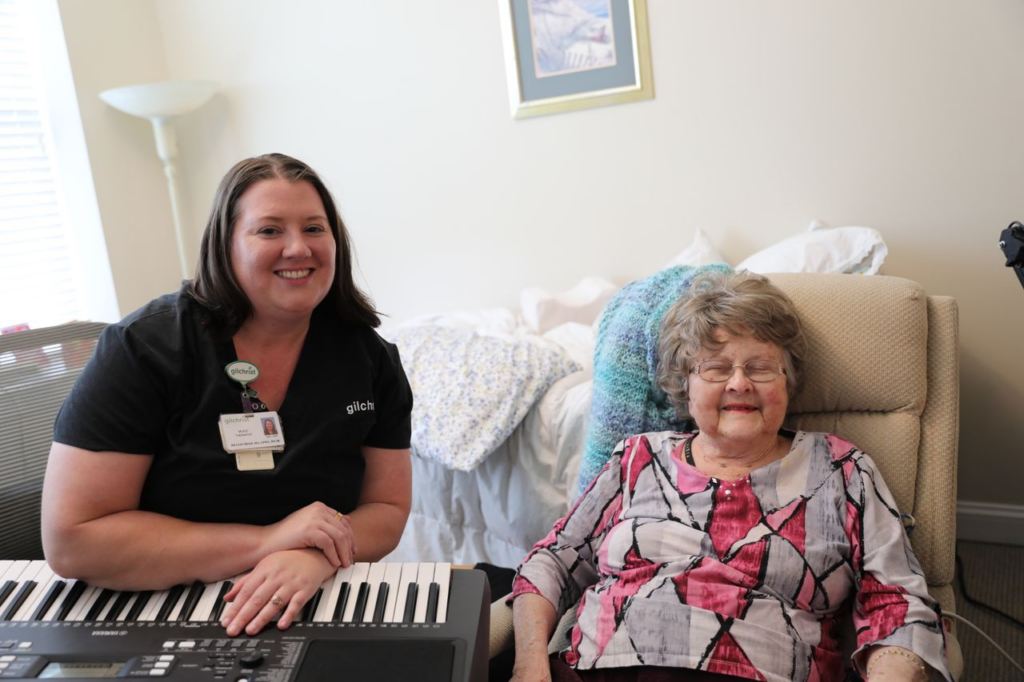
Even with those physical limitations, music continues to bring Mary comfort and joy. During visits with Jillian, Mary sings familiar songs, harmonizes, and reflects on the memories music carries with it. “I have had the pleasure of meeting and working with Mary for several weeks,” Jillian shares. “She has shown great strength, resiliency, and humor during our time in music therapy. It’s so important to have this service available to those who need it, like Mary. We use songs and musical experiences to enhance her care.”
Jillian says music therapy helps patients reconnect with meaningful parts of themselves during difficult times. “Through music therapy, Mary is able to experience joy, a sense of belonging, and purpose,” she says. “Music has always been a part of her life and will continue to be by her side throughout her personal journey.”
Unlike popular belief, music therapy is much more than simply singing to patients. Gilchrist’s Music Therapy Program offers individualized interventions designed to address emotional, physical, spiritual, cognitive, and social needs. Sessions may include singing, instrument playing, improvisation, relaxation techniques, lyric discussion, and opportunities for reminiscence and connection. For patients like Mary, music can help preserve identity, spark memories, reduce anxiety, and create moments of peace and joy.
Rediscovering the Joy of Playing Again
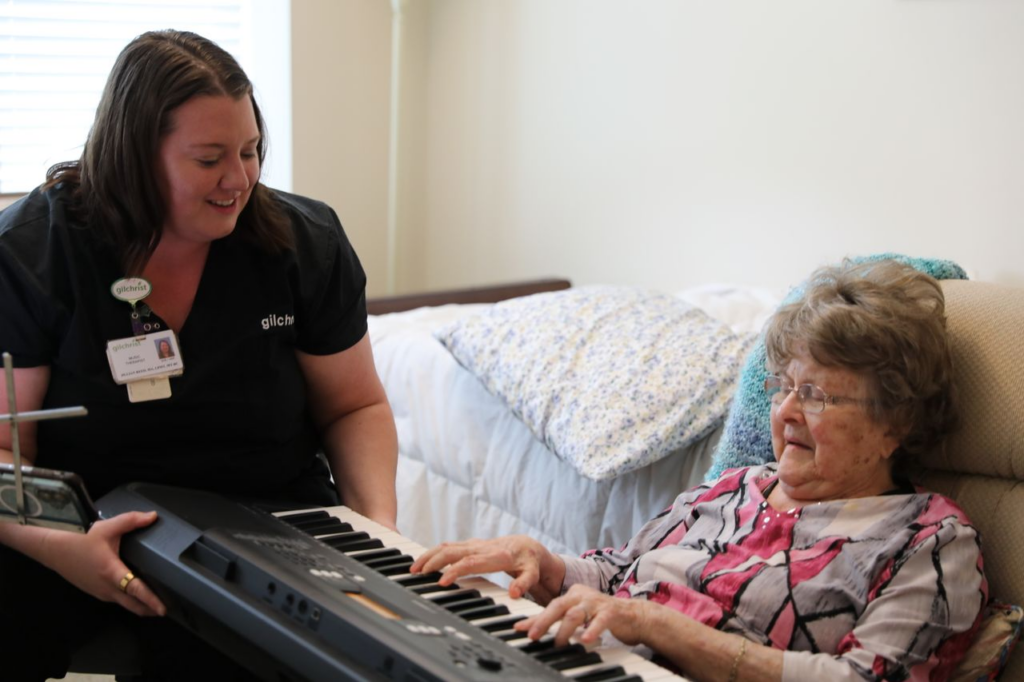
During one of her recent music therapy visits with Jillian Reed, Mary experienced something she never expected would be possible again. Jillian brought along her portable piano keyboard and gently positioned it on Mary’s chair so she could comfortably reach the keys. Despite the challenges neuropathy has created for her hands and mobility, Mary was able to play a little during the session. The moment brought her tremendous joy.
“After I sold my piano, I never thought I’d be able to play again,” Mary shares. “With the neuropathy, it’s just become too difficult.” For Mary, the experience was more than simply playing notes on a keyboard. It was a return to a lifelong passion that has shaped nearly every chapter of her life. Through Gilchrist’s Music Therapy Program, patients like Mary are able to reconnect with meaningful memories, treasured passions, and moments of comfort and joy.
To learn more about Gilchrist’s Music Therapy Program and how Gilchrist supports patients and families, visit https://gilchristcares.org/support/music-therapy/