

Priya’s Perspective: The Neurochemistry of Holding Hands
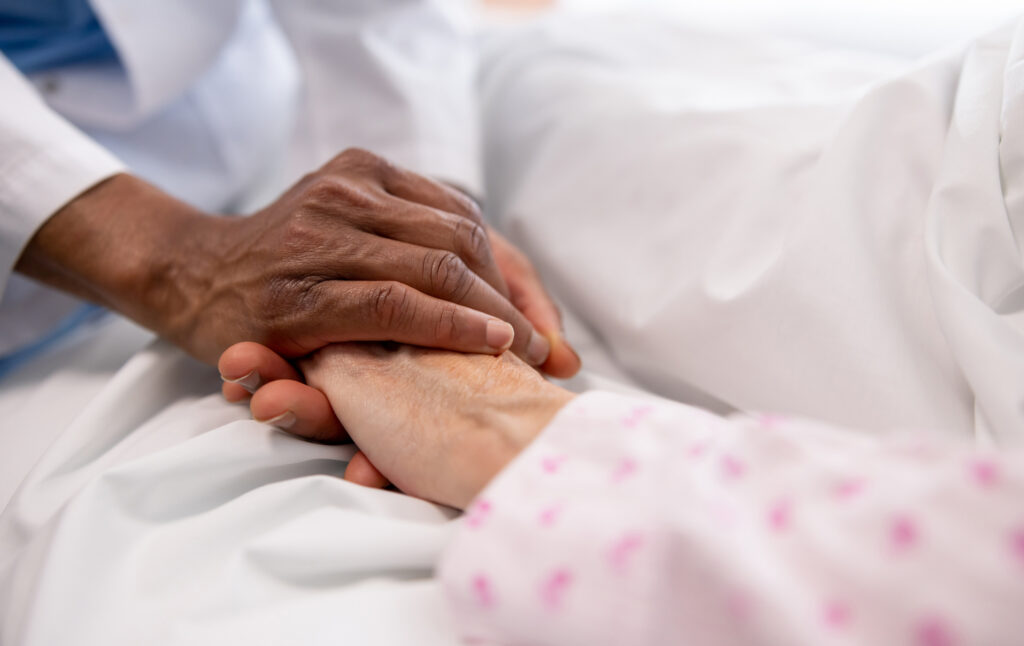
During my volunteer shifts with Gilchrist, I often find myself sitting in rooms wrapped in total silence. I may be stationed at the bedside of a patient who is entirely non-verbal, resting in the deep and quiet stages of end-of-life transition. In those times, there are no profound final words to exchange, no crosswords or puzzles to engage in, and no tasks for me to perform. The first time I was in this situation, my mind instinctively guided me to a simple (and rather universal) human act: I recall reaching out and gently holding her hand. I remember it clear as day; the comfort it brought me, the way my own heartbeat slowed, too. But I also remember the analytical voice in my head asking, Is this actually doing anything? Can they even feel this, or am I just doing this to comfort myself? After engaging in some research, it turns out neuroscience has a rather extraordinary answer to that question. By looking at the biology of the human nervous system, we can see that a slow, gentle touch is a precise and powerful intervention that directly communicates safety to the brain.
A Tale of Two Touches
To understand why a bedside hand-hold matters so much, we must first understand that humans possess two entirely separate touch systems in their skin. The first system is what most of us think of when we imagine the sense of touch. It relies on fast, highly insulated nerve pathways called A-beta fibers. These fibers are built for speed and analysis. If you touch a hot stove, sharp braille, or a rough piece of sandpaper, your A-beta fibers instantly fire signals to your somatosensory cortex. They tell your brain what you’re touching, where it is, and how fast it’s moving. Essentially, this system is an analytical, objective system designed to help us manipulate tools and avoid danger.
Tucked alongside those rapid fibers is an entirely different and long-overlooked network of nerves: C-tactile (CT) afferents. Unlike the fast A-beta fibers, CT fibers are unmyelinated, which essentially means they lack the fatty insulation that speeds up electrical signals. They move at a rather leisurely pace – up to 50 times slower than their analytic neighbors. What makes them especially fascinating, however, is that they completely ignore textures, shapes, and tools. CT fibers are exclusively tuned to respond to one specific input: a gentle touch.
The Physics of the Caress Frequency

Neuropsychologists have mapped the exact trigger mechanics of these C-tactile fibers, and the results are incredibly interesting. CT fibers fire at their absolute maximum capacity when skin is stroked gently at a velocity of roughly 1 to 10 centimeters per second (Pawling et al., 2017). Furthermore, these fibers are optimally tuned to human skin temperature. They are, quite literally, hardwired to detect mammalian affection and care. Crucially, CT fibers are only found in “hairy skin” – including the back of the hand, the forearm, the shoulder, and the face. They are completely absent from the hairless palms of our hands or soles of our feet. When a volunteer sits at a bedside and gently strokes the back of a patient’s hand at a slow speed, they are perfectly activating this dedicated neural pathway.
Bypassing the Mind

So, what happens inside the brain when these fibers are activated? This is where palliative touch truly shines. When fast A-beta fibers fire, they essentially send data to the thinking, analyzing parts of the brain. But when slow C-tactile fibers fire, they bypass the analytical centers entirely. Instead, they project directly to the posterior insular cortex, which is a region of the brain responsible for interoception, our internal sense of homeostatic balance. Furthermore, according to research on social touch – detailed in the Review on Social Touch and Human Development (Cascio et al., 2019) – the activation of this pathway triggers a powerful neurochemical reaction. Firstly, it immediately reduces activity in the amygdala, which is the brain’s alarm system. It also stimulates the immediate release of oxytocin (the bonding hormone) and opioids (natural painkillers).
When a hospice patient is transitioning, their conscious mind may slowly dim. They may no longer grasp the complex words of reassurance we offer. The C-tactile system, however, remains a resilient bridge. The next time you hold a hand or gently stroke an arm at the bedside, understand that you are speaking directly to their ancient, emotional brain. Even when words fail, our biology ensures that compassion will always be felt.
References
A Delta Fiber – an overview | ScienceDirect Topics. (n.d.). Www.sciencedirect.com. https://www.sciencedirect.com/topics/neuroscience/a-delta-fiber
Cascio, C. J., Moore, D., & McGlone, F. (2019). Social touch and human development. Developmental Cognitive Neuroscience, 35, 5–11. https://doi.org/10.1016/j.dcn.2018.04.009
Ingvars Birznieks, & Ingvars Birznieks. (2025). C‐tactile afferents: The mystery of human emotional touch has been hidden hair‐deep. The Journal of Physiology, 603(16), 4441–4442. https://doi.org/10.1113/jp289528
Li, Q., Zhao, W., & Kendrick, K. M. (2022). Affective touch in the context of development, oxytocin signaling, and autism. Frontiers in Psychology, 13. https://doi.org/10.3389/fpsyg.2022.967791

Bio
Priya Bakshi is a junior at Wilde Lake High School and one of Gilchrist’s first Gen2Gen teen volunteers, inspired by both her mother’s service and her own family’s experience with serious illness. Through her visits with patients, Priya brings a thoughtful perspective that blends curiosity, compassion, and a deep appreciation for the power of simply being present.