

Reconnecting Through Hospice: In the End, Love Answered
In hospice, moments of connection can happen when you least expect them. A familiar song, a shared memory, or even a simple phone call can open a door that’s been closed for years. At Gilchrist, these moments remind us that hospice isn’t only about the end of life, it’s about bringing people together when time matters most.
For social worker, Alicia Harkum, one of those moments came at Gilchrist Center Baltimore, when a patient named Claude “Andy” Anderson expressed one final wish: to speak with his daughters again.
A Father’s Story
Andy was born and raised in North Carolina, where his easy smile and love of dancing made him the life of any gathering. He later moved to Brooklyn, New York, where he had three daughters. One of them, Annetta, Jeannie’s twin sister, passed away in childhood—a loss that remained close to Andy’s heart.

Even after Andy and the girls’ mother went their separate ways, he continued to be a loving father. Jeannie and Alicia remember their dad braiding their hair, dressing them for school, and always making sure they had what they needed. “He was a good dad,” Jeannie shares. “He took care of us.” Though life pulled them apart at times, mostly because of tension surrounding his relationship with their mom, Jeannie says, she and Alicia never stopped loving him. “No matter what happened, we always loved him.”
As time went on, Andy met and married a woman named Gail, and he moved to Baltimore. In those later years, Andy and his daughters lost touch, not out of anger or indifference, but because of miscommunication and a father’s pride—the kind that makes it hard to reach out, even when the heart longs to. Still, Jeannie says our love for him never changed. “Pride will stop you from being with your family,” she reflects. “But we always loved him.”
Finding His Daughters
When Andy arrived at Gilchrist Center Baltimore, in May 2025 with pancreatic cancer, he carried one simple wish: to speak with his daughters again. Over the next few months, social worker Alicia Harkum searched tirelessly for them, using online people-finder tools, phone directories, and every lead they could find based on the names Andy had given them.
“As his condition progressed, he wasn’t always able to have clear conversations,” Alicia recalls. “Then, finally, one morning, he rallied. He was alert, talking clearly again—and this time, he was able to spell their last name correctly.” Alicia rushed back to their desk and entered the correct spelling—Alston—into their search. After countless calls and voicemails, they finally reached Andy’s youngest daughter, Alicia “Lisa” Alston.
Andy’s daughter, Lisa, was shocked and relieved when she got the call. She explained that she hadn’t spoken to her father in years, despite her sister Jeannie trying many times to find him—even requesting a police welfare check that never connected them. Lisa and Jeannie were grateful just to know where he was, and even more grateful for the chance to speak with him again.
After hanging up with Lisa, Alicia rushed back to Andy’s room. “I told him, ‘Andy, I found your daughter—do you want to talk to her?’” they say. “He nodded right away.” They called Lisa back and held the phone on speaker so Andy could hear. Lisa quickly looped in her sister, Jeannie, and the room filled with their voices.
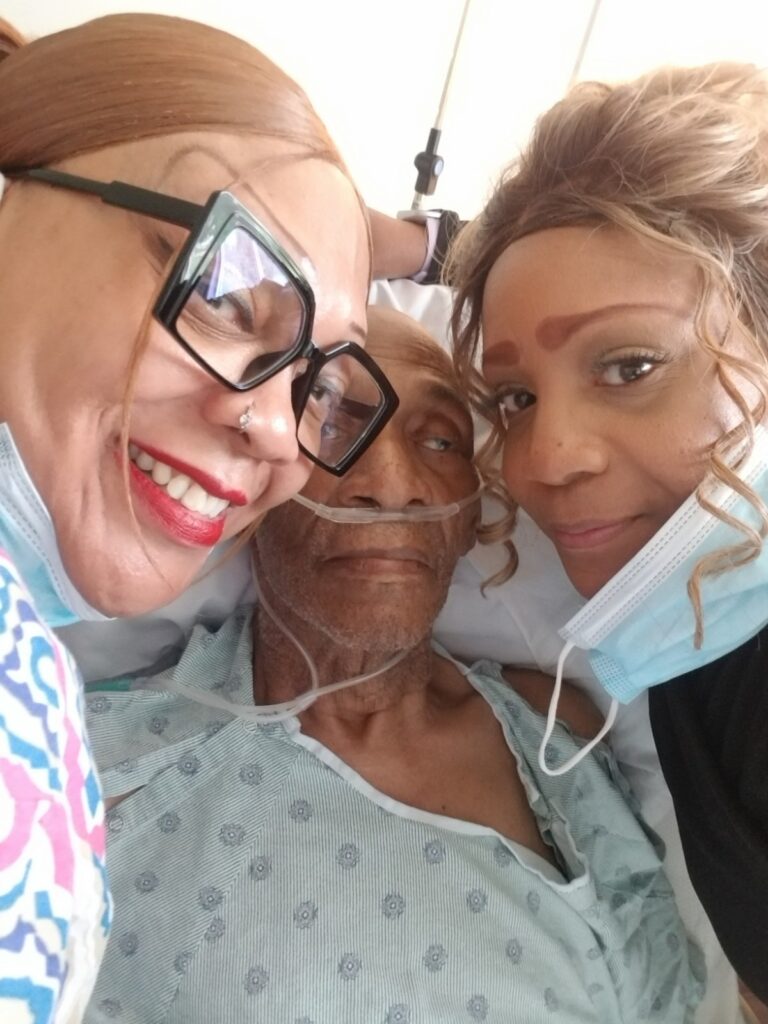
“We love you,” the sisters said as their father listened. Andy began to apologize, but his daughters gently stopped him. They told him they had already forgiven him and just wanted to be there for him.
That night, Jeannie and Lisa packed overnight bags and left from New York and New Jersey. By the next morning, they had reached Baltimore and arrived at Gilchrist to see their father in person. Although Andy’s rally had passed, he was aware of their presence, his eyes opening as they entered, his hand squeezing theirs. They spent the day by his bedside, talking softly, holding his hands, and assuring him that he was loved.
Andy passed away early the next morning, only hours after hearing his daughters’ voices again. Because Alicia kept calling, a family was made whole—just in time. “I’m grateful we could bridge that gap when it mattered most. I won’t forget that moment,” Alicia recalls.
For Jeannie, a Reverend, the reunion felt like divine timing. “Because they kept calling,” Jeannie says, “we found each other in time.” Before leaving Gilchrist, one of Andy’s close friends placed his well-worn Bible in Jeannie’s hands—pages filled with notes and highlights. Andy had asked that it be given to her. She saw it as a blessing and a message: to continue his faith, to preach the word, and to carry forward the peace they’d found together in those final hours.
A Place of Connection
For Alicia, moments like this are what define the role of a hospice social worker. It’s about listening, noticing, and acting when a small window of opportunity opens.
Social workers are often the bridge between a patient’s needs and the support systems that bring comfort and peace. They coordinate care, connect patients with community resources, offer emotional support and counseling, and help families prepare—practically and spiritually—for what lies ahead. Sometimes that work happens through emotional support, sometimes through advocacy—and sometimes, as in Andy’s case, through a simple phone call that changes everything. “We focus on what the person wants and what matters most to them,” Alicia says. “The goal is dignity, always.”
At Gilchrist, hospice is about connection—human to human, heart to heart. Sometimes that connection looks like a nurse holding a hand. And sometimes, it’s a social worker making one more call to reunite a family before it’s too late.
Because Alicia didn’t stop searching—because they made one more call—Andy’s daughters were able to hold his hand and say goodbye. That’s the heart of hospice care: people who don’t give up when it matters most.
To learn more about Gilchrist, visit: https://gilchristcares.org/